
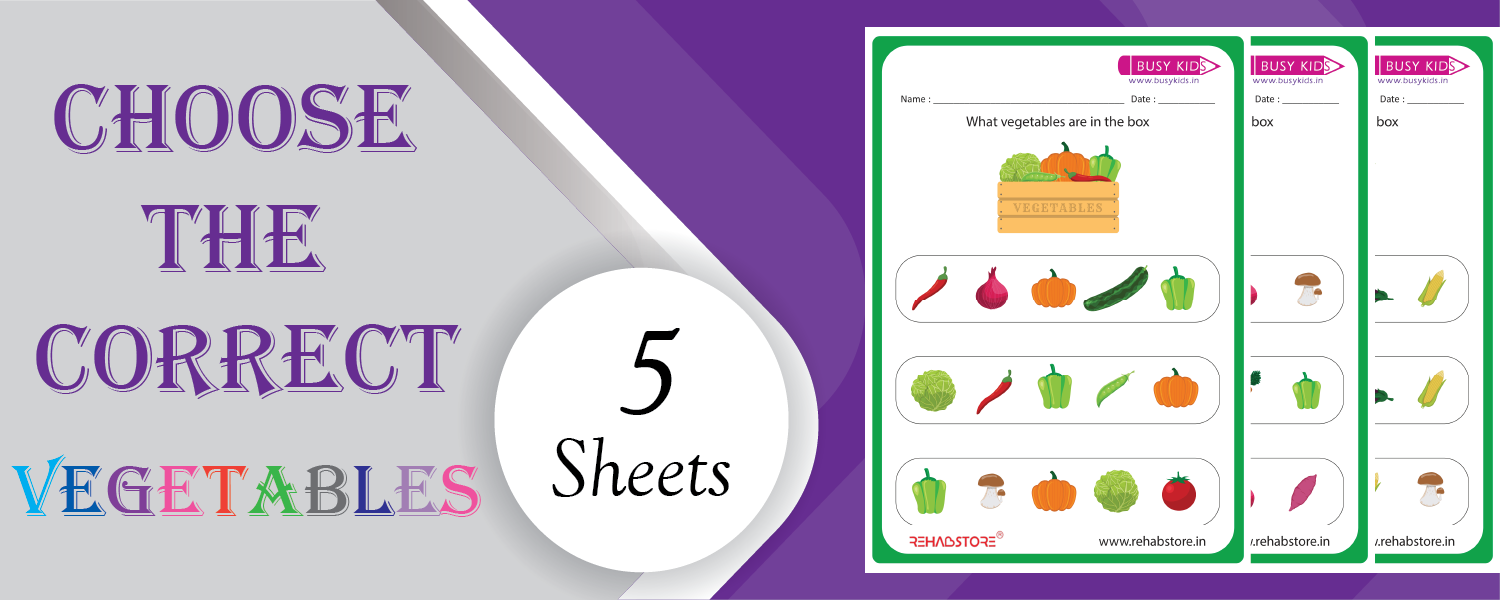
What vegetables are in the box
Item Code : 001019
The What Vegetables Are in the Box? Workbook is specially designed to help children develop observation skills, visual discrimination, vegetable recognition, and identification abilities through fun and interactive vegetable-themed activities. This engaging workbook encourages young learners to carefully observe a vegetable box, identify the vegetables hidden inside, and select the correct answers from multiple choices while strengthening important cognitive and early learning skills.
Each worksheet presents a colorful vegetable box filled with different vegetables. Children carefully examine the vegetables visible inside the box and compare them with several answer choices shown below. By identifying which vegetables are actually present, learners strengthen visual perception, concentration, attention to detail, memory, and logical reasoning while making learning enjoyable and interactive.
The workbook includes a wide variety of vegetable-themed activities featuring broccoli, tomato, eggplant, corn, carrot, onion, mushroom, cabbage, pumpkin, cucumber, garlic, potato, green chili, capsicum, peas, sweet potato, and many other familiar vegetables. Through repeated practice, children become more familiar with different vegetables while improving vegetable recognition and observation skills.
The guided activities support visual discrimination development by encouraging children to identify similarities and differences between vegetables. As learners compare shapes, colors, sizes, textures, and vegetable features, they strengthen observation abilities, visual memory, critical thinking, decision-making skills, and cognitive flexibility that are important for academic success and everyday learning.
The workbook also promotes fine motor development, hand-eye coordination, visual tracking, and focus as children circle, mark, or identify the correct vegetables. These activities improve concentration, accuracy, patience, and confidence while encouraging independent learning and active participation.
Designed with colorful illustrations, child-friendly layouts, engaging vegetable themes, and easy-to-follow activities, this workbook is suitable for preschool children, kindergarten learners, homeschool programs, classroom learning, remedial education, special education support, and occupational therapy activities.
Repeated practice helps children build confidence in visual recognition, observation, memory retention, and logical thinking while strengthening early cognitive development. These foundational abilities support reading readiness, visual learning, vocabulary growth, and overall academic development.
The structured What Vegetables Are in the Box? Workbook provides a strong foundation for developing observation skills, visual discrimination abilities, vegetable recognition, concentration, logical reasoning, and early cognitive confidence through fun and interactive vegetable-identification challenges.
What’s Included
• Vegetable identification activities
• Visual discrimination exercises
• Observation and comparison worksheets
• Vegetable recognition challenges
• Memory-building activities
• Logical thinking and reasoning exercises
• Visual perception development tasks
• Concentration and focus activities
• Fine motor and visual tracking exercises
• Vocabulary-building vegetable learning activities
• Child-friendly illustrated worksheets
• Printable high-quality PDF workbook
• Name & Date sections for progress tracking
Key Benefits
• Improves vegetable recognition and identification skills
• Strengthens visual discrimination abilities
• Enhances observation and attention to detail
• Develops memory and visual processing skills
• Supports logical thinking and problem-solving development
• Encourages critical thinking and decision-making skills
• Improves concentration and focus
• Strengthens fine motor and hand-eye coordination skills
• Builds vocabulary and vegetable awareness
• Suitable for homeschool, classroom, and therapy use
• Supports early cognitive development and school readiness
• Makes learning interactive, fun, and engaging