
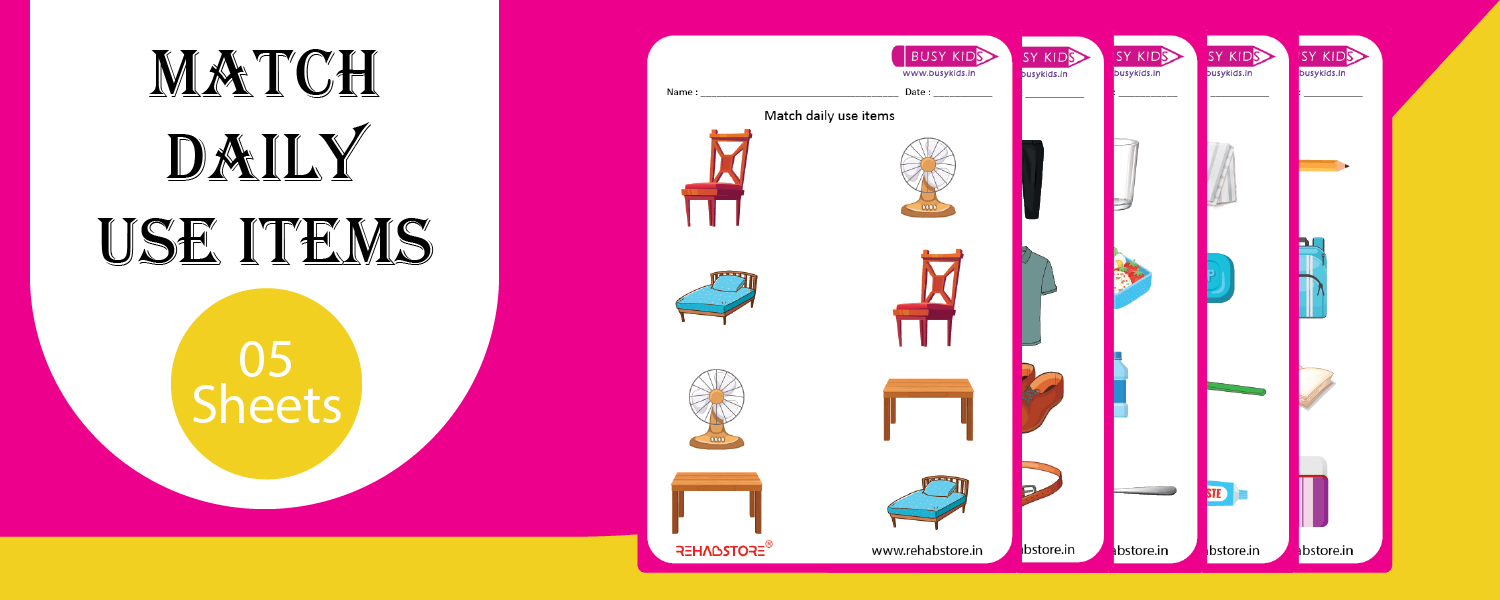
Match Daily Use Items
Item Code : 000976
The Daily Use Items Matching Worksheet Workbook is specially designed to help children identify and recognize common daily use items through simple and engaging matching activities. This interactive workbook encourages young learners to carefully observe everyday object pictures, compare visual details, and correctly match identical daily use items in a fun and child-friendly learning environment that supports early learning and visual development.
Each worksheet contains colorful pictures of daily use items placed on both sides of the page, where children carefully identify matching objects and draw lines to connect the correct pairs. These structured matching exercises help strengthen object recognition skills, observation abilities, concentration, visual discrimination, memory, and logical thinking while building confidence in independent learning activities.
The workbook includes multiple practice pages featuring common daily use items such as toothbrush, toothpaste, soap, towel, water bottle, spoon, lunch box, school bag, pencil, eraser, book, shirt, shoes, belt, chair, bed, fan, table, and more. These engaging object matching activities help children become familiar with everyday items, their appearances, shapes, and functions while improving visual recognition and comparison skills through repeated practice exercises.
The guided matching activities also support fine motor development, visual–motor coordination, and hand–eye coordination as children carefully draw lines to connect identical object pictures. The workbook uses clean layouts, spacious activity areas, colorful illustrations, and easy-to-follow worksheet patterns that make learning enjoyable, stress-free, and suitable for preschool, nursery, and kindergarten learners.
Repeated practice activities help children build confidence in identifying daily use items, recognizing visual similarities and differences, improving concentration, and processing visual information more accurately. These early learning experiences support memory retention, visual learning abilities, observation skills, vocabulary development, and cognitive growth that are important for school readiness and overall early childhood development.
The workbook also encourages independent thinking, active participation, focus, and observation-based learning through fun picture-matching activities. By carefully identifying and connecting daily use item pictures, children improve visual recognition abilities and strengthen early educational skills in a playful and interactive way.
Designed with engaging worksheet layouts and beginner-friendly matching activities, this workbook is ideal for preschoolers, nursery children, kindergarten learners, homeschool programs, classroom practice, remedial education, special education support, and occupational therapy learning activities. The structured Daily Use Items Matching system provides a strong foundation for developing observation skills, object recognition abilities, concentration, visual learning skills, hand–eye coordination, and early cognitive confidence through fun and interactive practice.
What’s Included
• Daily use items matching activities
• Object recognition and comparison worksheets
• Matching exercises with common everyday items
• Draw-the-line matching activities
• Observation and concentration development exercises
• Visual discrimination and memory practice
• Everyday object identification learning activities
• Fine motor and hand–eye coordination exercises
• Child-friendly illustrated worksheets
• Interactive early learning activities
• Printable high-quality PDF workbook
• Name & Date sections for progress tracking
Key Benefits
• Improves daily use item recognition skills
• Strengthens observation and matching abilities
• Enhances concentration and attention to detail
• Develops visual discrimination and comparison skills
• Supports memory and visual processing development
• Encourages vocabulary and object identification skills
• Strengthens fine motor and hand–eye coordination skills
• Builds confidence in independent learning activities
• Helps children recognize and identify common daily use items accurately
• Suitable for homeschool, classroom, and therapy use
• Supports early learning and cognitive development
• Makes learning interactive, fun, and engaging